

A practical guide to getting the most out of natural cooking fat — from your first fry to seasoning your cast iron.
Most people come to beef tallow through the health argument. They read about the problems with seed oils, they hear that tallow is what South African kitchens ran on for generations, and they decide to make the switch. Then the jar arrives and they stare at it.
It is solid at room temperature. It is pale yellow or white depending on the source. It smells faintly animal if you lean in. It is nothing like the bottle of sunflower oil it is replacing, and there is no instruction manual telling you what to do with it.
This post is that manual. What tallow can cook. How hot it can go. What it does to the flavour of your food. How to store it, how to use it, and what to expect the first time you drop a spoonful into a pan.
Why Tallow Belongs in a Cooking Kitchen
Before getting into the practical side, it is worth understanding why tallow is a superior cooking fat for the specific jobs South African home cooking asks of it.
Heat stability
Beef tallow has a smoke point of approximately 200°C (400°F) for unrefined tallow and up to 250°C (480°F) for refined tallow — well above the temperature of a braai grid, a hot cast iron pan, or a deep fryer. At these temperatures, most vegetable oils begin to oxidise and break down, producing aldehydes and other compounds that have been linked to cellular damage. A review published in Acta Scientific Nutritional Health (2018) found that polyunsaturated-heavy oils like sunflower, canola, and corn oil produce significantly higher levels of toxic oxidation products at high heat than saturated fats such as tallow.
Tallow’s high saturated fat content is precisely what makes it stable. Saturated fat molecules have no double bonds to break under heat, which is why they do not oxidise the way unsaturated fats do. The fat your grandmother fried in stayed stable at high heat. The oils that replaced it often do not.
Flavour
Tallow adds a depth of flavour to food that neutral vegetable oils simply cannot. It is not a strong or overpowering taste — it is more of a richness that makes fried food taste more like food. Potatoes fried in tallow taste the way chips used to taste before fast food chains switched to seed oils. Steak seared in tallow develops a crust with a savouriness that butter alone does not achieve.
Grass-fed tallow has a slightly more pronounced flavour than standard tallow due to its higher beta-carotene and CLA content. For most cooking this is an advantage. For very delicate dishes where a completely neutral fat is needed, standard natural tallow is the better choice.
Nutritional value that survives cooking
Unlike most cooking oils, tallow retains its nutritional profile through the cooking process. The fat-soluble vitamins A, D, E, and K in grass-fed tallow are heat-stable and do not degrade at normal cooking temperatures. The CLA and omega-3 content in grass-fed tallow also survives the heat of frying and roasting. You are not just cooking with a stable fat — you are cooking with one that still carries nutritional value when it reaches the plate.
Smoke Points at a Glance
| Fat | Smoke Point | Notes |
| Beef tallow (unrefined) | ~200°C | Ideal for frying, searing, roasting |
| Beef tallow (refined) | ~250°C | Suitable for very high-heat cooking |
| Butter | ~150°C | Burns quickly at high heat |
| Extra virgin olive oil | ~160°C | Best for low heat and finishing |
| Sunflower oil (refined) | ~225°C | Stable at high heat but polyunsaturated — oxidises over time |
| Coconut oil | ~177°C | Adds strong coconut flavour |
What You Can Cook With Tallow
Frying and deep frying
Tallow is one of the best fats available for deep frying. Its high smoke point, heat stability, and resistance to oxidation make it ideal for anything that needs sustained high heat — chips, vetkoek, koeksisters, chicken, fish. Before seed oils took over the fast food industry in the 1980s, most commercial deep frying was done in beef tallow. The flavour difference was so pronounced that when chains switched to vegetable oil, they had to add flavour back in artificially.
For home deep frying, use enough tallow to fully submerge what you are cooking. Heat it to 170°C to 180°C for most applications — a small piece of bread dropped in should sizzle immediately and brown within 30 seconds. Do not overcrowd the pan, as this drops the temperature and leads to greasy rather than crisp results.
Pan frying and searing
For pan frying, tallow outperforms most alternatives. A tablespoon in a hot cast iron pan gives you an even, high-heat surface that sears meat without sticking and builds a proper fond — the caramelised residue at the bottom of the pan that forms the base of a good pan sauce.
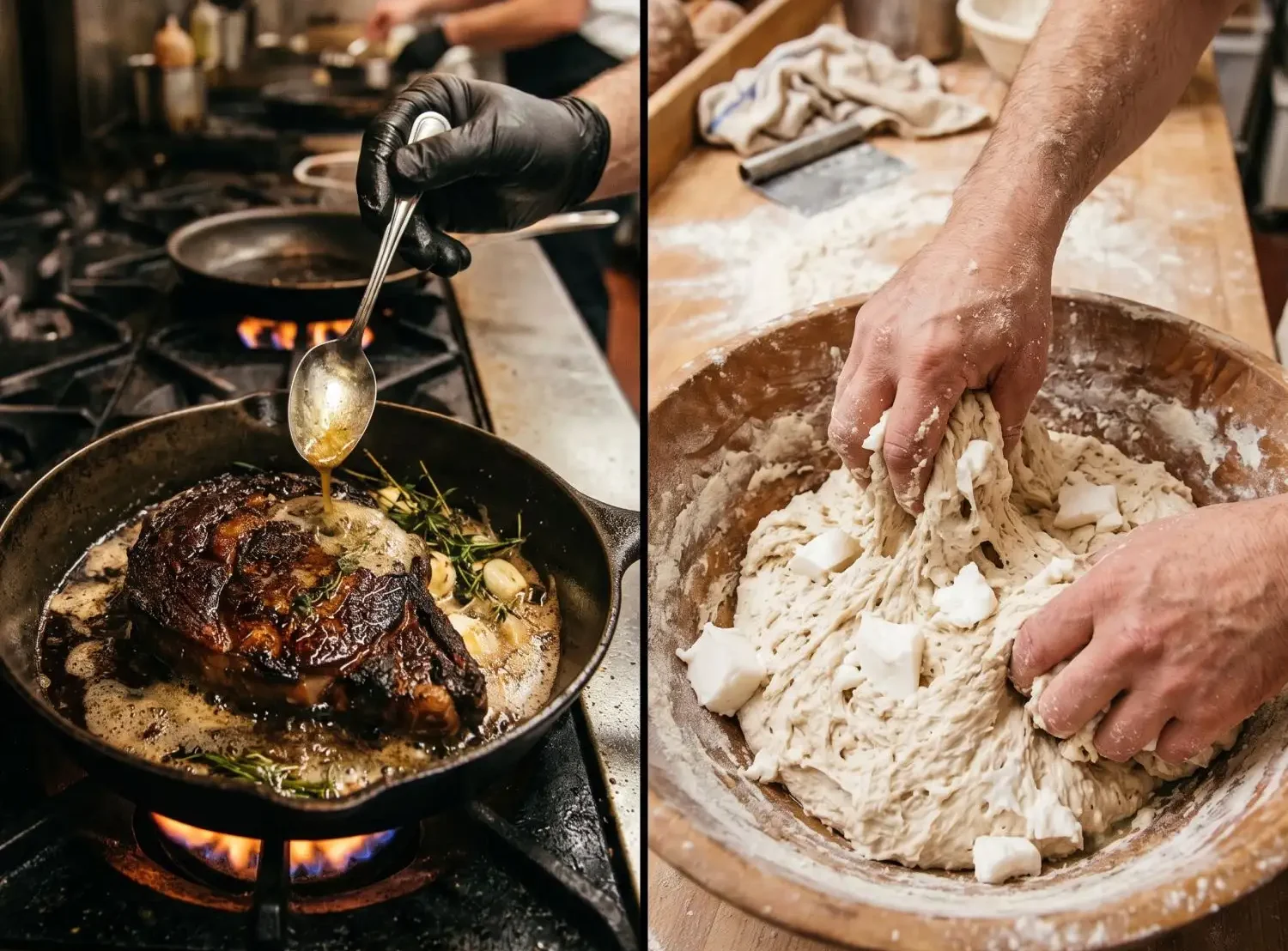
For steak, heat the pan until it is very hot before adding the tallow. Add your steak once the fat begins to shimmer. The combination of the tallow’s smoke point and its flavour compounds produces a crust that is difficult to replicate with any other fat. Add a knob of butter, a garlic clove, and a sprig of rosemary in the last minute and baste continuously for a result that is equal to any restaurant-prepared steak.
Roasting
Replacing vegetable oil with tallow in a roasting tray transforms potatoes, root vegetables, and roast chicken in a way that is immediately obvious. Tallow coats the outside of the food and conducts heat evenly, producing a crust that is crisp rather than soggy and retains its texture as the food cools.
For roast potatoes: parboil until the edges just begin to soften, drain and shake vigorously in the pot to rough up the surface, then toss in hot tallow in a preheated roasting tray. The roughed-up surface absorbs the fat and crisps dramatically. Roast at 200°C until deeply golden — approximately 45 minutes for a medium-sized potato.
For roast chicken: rub tallow under and over the skin before roasting. The fat bastes the bird from within as it melts, keeps the breast meat moist, and crisps the skin to a deep golden brown.

Braai and open-fire cooking
Tallow is exceptionally well suited to braai cooking. For boerewors and chops it adds nothing except heat — the fat renders out of the meat naturally and the tallow in the grid simply prevents sticking. For less fatty cuts like chicken breast or fish, brush the grid or the food itself with melted tallow before placing it over the coals. It handles the heat of a hardwood fire without flaring or smoking excessively the way oil-based marinades can.
A practical tip for braai cooking: keep a small jar of tallow next to the fire. Use a pastry brush to apply it to the grid before the food goes on, and again at the halfway point if the food is sticking. It is a cleaner and more effective approach than spraying oil over hot coals.
Baking
Tallow is a traditional baking fat with a longer history in South African kitchens than butter. It produces a short, crumbly pastry that is excellent for savoury pies, rusks, and traditional biscuits. The flavour is neutral enough for most baking applications, though for sweet baking where a completely clean fat is needed, refined tallow or a combination with butter is the better choice.
As a direct substitution: replace vegetable oil with melted tallow at a 1:1 ratio by volume. Replace butter with tallow at a slightly lower ratio — roughly 3/4 cup tallow for every 1 cup of butter — as tallow contains no water and produces a drier result.
Eggs
Eggs fried in tallow are, simply, better. The fat gives the whites a crisp, lacy edge while the yolk stays runny — the kind of fried egg that does not need any intervention. Use a moderate heat, add a generous teaspoon of tallow to the pan, let it melt and begin to shimmer, then add the egg. Baste the white gently with the hot fat using a spoon. Done in under two minutes.
Seasoning cast iron
Tallow is one of the best fats for seasoning cast iron cookware. Apply a very thin layer — wipe on with a cloth and then wipe almost all of it off — and bake upside down in an oven at 200°C for one hour. The fat polymerises onto the surface and builds the non-stick layer that makes cast iron worth using. Repeat three to four times for a new pan. Maintain by wiping with a thin layer of tallow after each use.
How to Store Tallow
Tallow is one of the most shelf-stable cooking fats available. Its low moisture content and high saturated fat ratio make it resistant to rancidity without refrigeration.
- At room temperature: Tallow keeps for up to 12 months in a sealed container away from direct sunlight. In a South African summer kitchen it will be soft or liquid — this is normal and does not affect quality.
- Refrigerated: Indefinitely. Cold tallow is very firm — allow it to come to room temperature before scooping, or warm the jar briefly in warm water.
- Frozen: Tallow freezes well and keeps for several years. Portion it into an ice cube tray before freezing for convenient cooking-sized amounts.
- Signs of rancidity: Tallow that has gone off smells sour or paint-like rather than faintly animal. Properly stored tallow should smell neutral to mildly savoury. If in doubt, discard.

Practical Tips for First-Time Users
- Tallow is solid at room temperature. To measure it, either melt the jar briefly in warm water, use a spoon to scoop out a rough amount, or simply cut off a slice with a knife from a cold block.
- A little goes further than you expect. Start with half the amount you would use of oil — you can always add more, and tallow spreads in the pan more readily than oil once it melts.
- The white film that may appear on the surface of stored tallow is crystallisation, not mould. Mould on tallow is rare and would appear as coloured spots with a musty smell. White or pale yellow crystallisation is harmless and dissolves when the fat is heated.
- Do not be alarmed if your grass-fed tallow smells different from grain-fed tallow. The more pronounced scent in grass-fed tallow is from higher beta-carotene and CLA content — it dissipates during cooking and does not transfer strongly to food.
- Keep a dedicated tallow jar near the stove. The convenience of having it to hand is one of the most underrated parts of switching from bottled oil — there is no dripping, no overflow, and no lid to wrestle with.
Which Tallow for Which Job
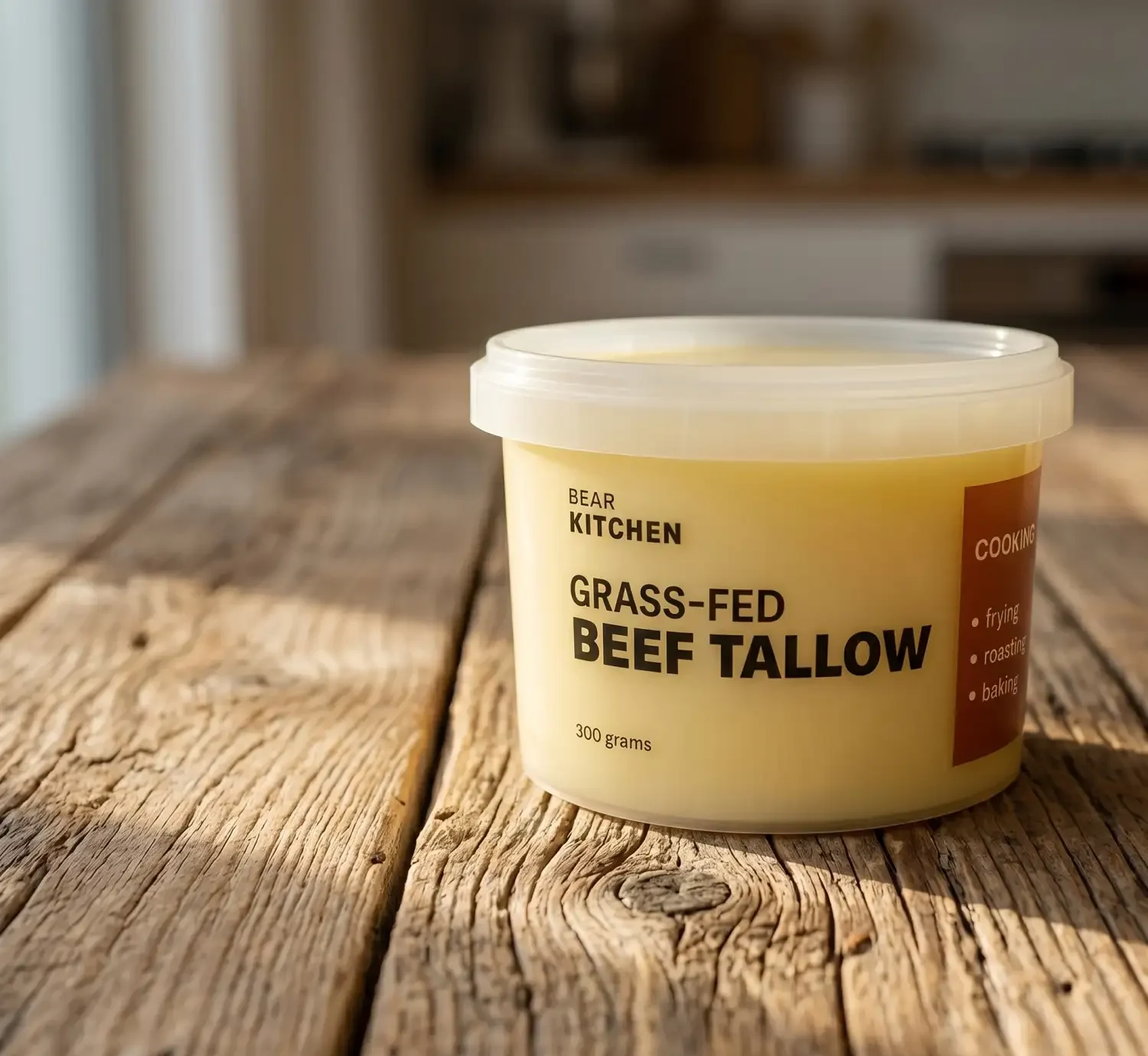
BEAR Kitchen grass-fed beef tallow is cold-pressed and retains a more pronounced flavour and colour from the pasture diet. It is the best choice for high-flavour applications — braai, searing, roasting, and eggs — where the richness of the fat contributes to the finished dish.
The Affieplaas natural beef tallow is a clean, neutral-flavoured cooking fat that is well suited to applications where you want the fat to do a job without announcing itself — everyday frying, baking, and pastry work where a more neutral base is preferred.
Both are stable at high heat, both store well at room temperature, and both are a meaningful improvement over the refined seed oils they replace. The choice between them comes down to flavour preference and how you are using the fat on any given day.
The Simple Version
Use it the way your ouma used it. Hot pan, solid fat, let it melt, add the food. Do not overthink the temperature, do not measure it precisely, and do not worry about whether it is going to work. Tallow has been doing this job in South African kitchens for generations. It knows what it is doing.