

There is a recipe in the book of Exodus — specific, detailed, and given with unusual weight. Four botanical ingredients, precise quantities, instructions for preparation. It was the formula for the sacred anointing oil used in the Tabernacle, and it was not assembled casually. The ingredients were chosen because they were considered the finest the known world had to offer.
Three of the four oils in Kings-Oil Wonder Oil appear in that recipe. The fourth appears elsewhere in scripture, equally valued. That is not a marketing claim — it is simply where these plants sit in the historical record, and it says something about the kind of ingredients they are.
Four Oils
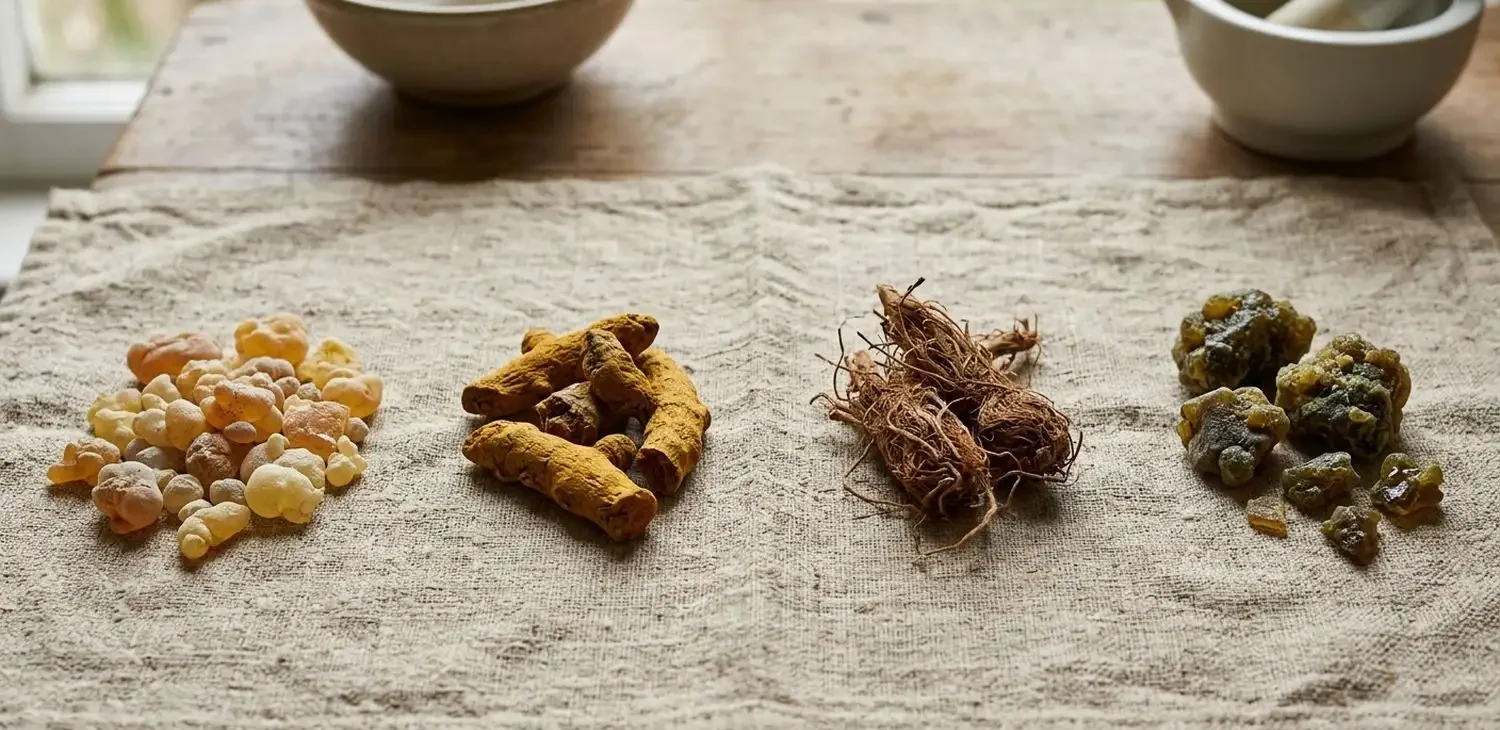
Wonder Oil is a topical blend of four plant-derived oils — Frankincense, Spikenard, Galbanum, and Turmeric — carried in a cold-pressed hemp and olive oil base. Cold pressing extracts oil using mechanical pressure only, without heat or chemical solvents, which preserves the natural properties of the oil. You apply it directly to the skin, massage it in, and let it absorb. There is no complicated routine and nothing synthetic in the bottle.
Each of the four ingredients has been in human use for thousands of years, across civilisations that had no contact with one another. That kind of independent convergence on the same plants is worth paying attention to.
Frankincense
One of the most documented healing ingredients in history. Frankincense is the resin of the Boswellia tree, native to the arid slopes of the Arabian Peninsula and the Horn of Africa — Oman, Yemen, Somalia, and Ethiopia. It has been prized across cultures for its anti-inflammatory properties and its ability to support tissue repair. It is warm and grounding in scent, and deeply soothing on the skin.
Melanie Haywood had been living with a frozen shoulder for years, relying on pain medication that gave her limited relief. After applying the oil for the first time, she was able to lift her arm above her head — something she had not managed in a long time.
Spikenard
Native to the high-altitude meadows of the Himalayas — growing between 3,000 and 5,000 metres above sea level across Nepal, India, and Bhutan — and traded across the ancient world at considerable cost. Spikenard appears in both the Old and New Testaments. In Ayurvedic medicine it has been used for thousands of years to calm the nervous system and ease pain. Within the blend it contributes antispasmodic and nervine properties alongside the anti-inflammatory core.
Tharien applies it to the back of her neck when a headache starts, and finds the pain eases as she massages it in.
Galbanum
Named in Exodus 30 as a component of the sacred incense burnt in the Tabernacle. Galbanum is a resin harvested from Ferula plants that grow on the mountain slopes of northern Iran — a region that has been supplying this ingredient to the ancient world for millennia. In natural health practice it is recognised for its anti-spasmodic and anti-inflammatory properties.
Turmeric
Native to the Indian subcontinent and Southeast Asia, turmeric has been used in traditional healing across Asia and the Middle East for centuries. The active compound is curcumin — a natural polyphenol widely studied for its anti-inflammatory action. Applied to the skin, it may help reduce localised inflammation and discomfort.
Jakes and Kathy Becker bought a bottle for the arthritis-related stiffness in Jakes’s hands. After a single use, he could open and close his fingers freely again. Kathy, who had a knee injury, started using it nightly for her own relief.
Wonder Oil and Wonderworking Oil — What Is the Difference?
Kings-Oil produces two products in this range, and the question comes up often enough that it is worth answering clearly.
The Wonderworking Oil is the producer’s recommended starting point. It carries the same foundation of biblical oils but brings in additional botanicals — Calamus and Cedarwood alongside Spikenard and Galbanum — making it a broader, faster-acting blend suited to acute pain relief. Most first-time buyers start here.
The Wonder Oil is the original formulation — the four oils, clean and concentrated, with the longest track record behind it. It is particularly suited to ongoing inflammation, skin support, sinus complaints, and general wellness rather than acute joint or muscle pain.
The Wonderworking Oil also comes in a Rosehip variant, which adds rosehip oil to the blend. Rosehip is rich in vitamins and essential fatty acids and is well regarded for its skin-healing and rejuvenating properties — suited to those dealing with pain that also has a skin or nerve component. The recommendation from the producer is to try the standard Wonderworking Oil first before moving to the Rosehip variant.
A Few More Voices
Not every experience maps neatly onto a single ingredient — pain has a way of being more complicated than that. These are the accounts that stood out from the rest of the verified feedback.
Theresa bought two bottles — one for her own lower back pain, one for her brother who had struggled with knee pain for years. Both found consistent relief.
Emily Hood had been dealing with burning feet for five months. After regular use, the burning stopped.
Fourteen reviews in total, all five stars. Shoulders, knees, hands, feet, lower back, headaches — different pain, same result.

How to Use It
Apply a small amount directly to the affected area and massage it in gently. Most people use it two to three times a day, or as needed. It absorbs without leaving a heavy residue.
If you are using this oil for the first time, do a patch test first. Apply a small diluted amount to the inner forearm, cover with a bandage, and leave for 48 hours. If there is no redness or irritation, you should be fine to use it normally. Essential oils can cause sensitivity in some individuals, and it is worth checking before applying to a larger area.
If you are pregnant or breastfeeding, consult a healthcare professional before use. Essential oils are concentrated botanical compounds, and while topical use at normal dilution is generally considered lower risk than ingestion, the safety profile during pregnancy is not fully established for all oils. The cautious approach is to check with your doctor or midwife first.
Important: Kings-Oil products are complementary medicines and have not been evaluated by SAHPRA for specific health claims. For external use only. If you have an underlying health condition or are taking medication, consult your healthcare practitioner before use.
Konings-Olie, the producer, sells direct to the public. We stock it at Toeka because it belongs alongside the other products here — things made properly, from real ingredients, with a track record that goes back further than most people expect.
In the case of Wonder Oil, considerably further.


