

The honest answer to the question everyone asks before buying tallow skincare for the first time.
If you have acne-prone skin, the idea of rubbing beef fat on your face probably sounds like a disaster waiting to happen. It is the most common objection to tallow skincare, and it is a fair one — conventional wisdom has spent decades telling us that oil causes breakouts, and that the answer is to strip and dry the skin as aggressively as possible.
That advice has not served acne sufferers particularly well. Acne rates have not declined. What has changed is the growing body of research suggesting that the problem is not oil itself, but the wrong kind of oil — and a compromised skin barrier that cannot regulate itself properly.
This post looks at what grass-fed beef tallow is, why it is structurally different from the synthetic oils in most skincare products, and what the evidence actually suggests about its effect on acne-prone skin.
The ‘Oil Causes Acne’ Myth — Where It Came From
The idea that oily skin causes acne led, logically enough, to the idea that removing oil from the skin would reduce acne. This drove decades of dermatological advice recommending oil-free moisturisers, foaming cleansers, and alcohol-based toners — all designed to strip sebum from the skin’s surface.
The problem is that stripping the skin’s natural oil does not reduce sebum production. It triggers it. The skin’s sebaceous glands respond to dehydration by producing more oil, not less, creating the cycle of over-cleansing and overproduction that many acne sufferers know intimately.
What drives acne is not oil in general. It is a combination of excess sebum production, a disrupted skin barrier that cannot regulate that production, inflammation, and the proliferation of Cutibacterium acnes bacteria in follicles blocked by dead skin cells. Addressing any one of these factors in isolation is less effective than supporting the skin’s own regulatory systems.
Why Tallow Is Structurally Different From Most Skincare Oils
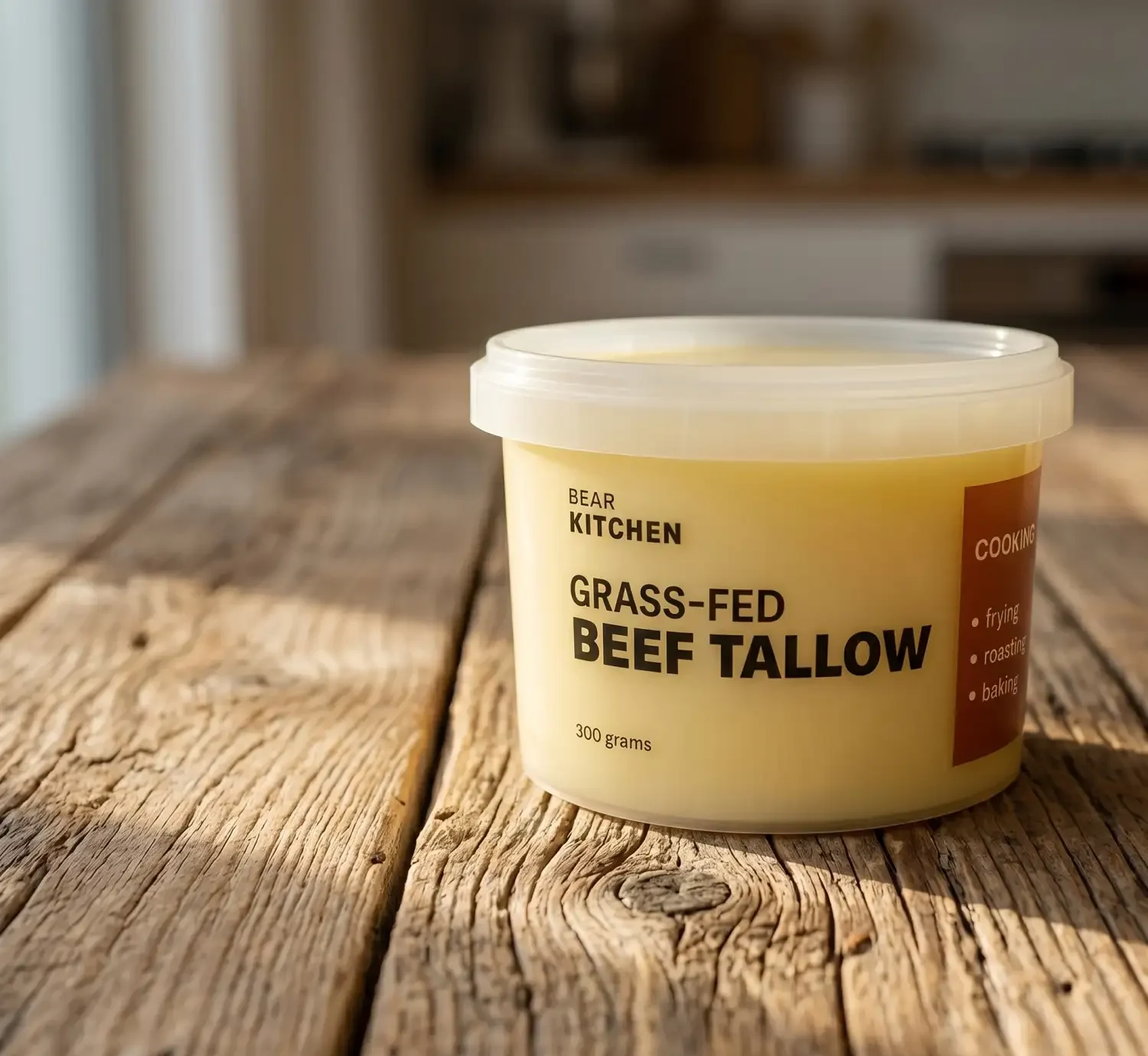
Grass-fed beef tallow is rendered from the fat around the kidneys of cattle. The result is a fat that is extraordinarily similar in composition to human sebum — the oil the skin produces naturally. This is not a marketing claim. It is a measurable fact about fatty acid profiles.
Human sebum is composed primarily of triglycerides, wax esters, squalene, and free fatty acids. Grass-fed beef tallow contains a very similar distribution: oleic acid, palmitic acid, stearic acid, and palmitoleic acid, along with fat-soluble vitamins A, D, E, and K.
This similarity matters because the skin’s barrier is designed to work with sebum-compatible fats. Synthetic silicones and many plant oils have molecular structures the skin does not recognise in the same way — they sit on the surface or create occlusive barriers without interacting meaningfully with the skin’s own biology.
The vitamins in grass-fed tallow and what they do for acne-prone skin
- Vitamin A (retinol): Vitamin A is one of the most well-established actives in acne treatment. Pharmaceutical retinoids are derived from it. In its natural form within tallow, vitamin A supports skin cell turnover, reduces the build-up of dead cells that block follicles, and has documented sebum-regulating properties. A review published in Dermato-Endocrinology (2012, Zouboulis et al.) confirmed vitamin A’s central role in sebaceous gland regulation.
- Vitamin D: Vitamin D deficiency has been associated with increased acne severity in multiple studies. A 2016 study published in the Journal of the European Academy of Dermatology and Venereology found that acne patients had significantly lower vitamin D levels than control groups, and that supplementation reduced inflammatory lesion counts. Tallow from grass-fed cattle contains meaningful quantities of vitamin D3.
- Vitamin E: Vitamin E (tocopherol) is a fat-soluble antioxidant with anti-inflammatory properties. It has been studied for its ability to reduce comedone formation and sebum oxidation — oxidised sebum is more strongly associated with inflammatory acne than unoxidised sebum.
- Conjugated Linoleic Acid (CLA): Grass-fed tallow contains higher levels of CLA than grain-fed tallow. CLA has documented antimicrobial properties and has been studied for its ability to reduce inflammatory cytokines in skin tissue. For acne driven by bacterial proliferation and inflammation, this is a relevant active.

The Skin Barrier Connection
Acne-prone skin frequently has a compromised skin barrier — a 2016 study in the Journal of Investigative Dermatology found that barrier dysfunction precedes and likely contributes to the inflammatory cascade in acne, rather than being a consequence of it. A skin that cannot regulate moisture and oil effectively becomes more susceptible to bacterial colonisation, inflammation, and the clogged follicles that produce breakouts.
Tallow’s fatty acid profile supports barrier repair rather than barrier disruption. Oleic acid and palmitic acid are the same fatty acids the skin uses to maintain its lipid matrix. Applied topically, they help the skin rebuild the structures it needs to regulate itself — reducing the over-production of sebum that characterises acne-prone skin that has been chronically over-stripped.
But Will It Block My Pores?
This is the question that stops most acne sufferers from trying tallow. The short answer is: probably not, and for many people the opposite is true.
Comedogenicity — the tendency of an ingredient to block pores — is rated on a scale of 0 to 5. Beef tallow typically rates between 2 and 3, which is the same range as many plant oils commonly recommended for sensitive and acne-prone skin, including olive oil (2) and avocado oil (3). For context, coconut oil — widely sold for skin use — rates 4.
Comedogenicity ratings are also highly individual. An ingredient that blocks pores for one person may be well tolerated by another, depending on skin type, follicle size, and how the skin responds to specific fatty acids. The only reliable way to know is to patch test before applying to the whole face.
What the structural evidence does support is that tallow — unlike petroleum-derived mineral oils or synthetic silicones — does not create an impermeable barrier on the skin’s surface. It absorbs, it interacts with the skin’s own biology, and it does not leave the kind of occlusive residue that traps debris in follicles.
How to Introduce Tallow Skincare if You Have Acne-Prone Skin
The transition period matters. If your skin has been using heavy synthetic moisturisers or has been chronically over-cleansed, it may take a few weeks to recalibrate. Some people experience a purging phase as the skin adjusts. This is not unique to tallow — any significant change in skincare routine can produce a short-term response.
- Start with a small amount. A pea-sized amount is enough for the whole face. Tallow is dense and a little goes a long way.
- Patch test first. Apply to a small area of your jawline or neck and monitor for 48 hours before applying to the full face.
- Use on clean, slightly damp skin. Applying to damp skin helps tallow absorb more evenly and reduces the amount needed.
- Give it four to six weeks. Skin cell turnover takes approximately 28 days in younger skin and longer as you age. One week is not enough time to assess whether a product is working for your skin type.
- Avoid combining with heavy synthetic products. If you are transitioning to tallow, simplify the rest of your routine to avoid confounding variables.
The Bottom Line
Grass-fed beef tallow is not a guaranteed solution for acne-prone skin. No topical product is. But the evidence does not support the assumption that it will make acne worse — and the structural case for its compatibility with acne-prone skin is stronger than many people realise.
If your skin is reactive, over-stripped, or locked in the cycle of oil production that follows aggressive cleansing, tallow is worth a considered trial. Its fat-soluble vitamin content, its sebum-compatible fatty acid profile, and its anti-inflammatory properties make it a meaningfully different option from the synthetic moisturisers that dominate the acne skincare market.