
Most spices have a single story. Turmeric has several. It is the spice that colours curry and dyes cloth. It is the ceremonial ingredient applied to brides at Hindu weddings. It is the Ayurvedic remedy that Indian physicians have been prescribing for longer than written records can reliably confirm. And it is, by some distance, one of the most extensively researched plant compounds in modern science — with thousands of published studies on its primary active compound, curcumin, and what it does inside the human body.
That breadth is not coincidence. It is the footprint of something genuinely useful, across genuinely different contexts, across genuinely different civilisations. This post covers what turmeric is, where it comes from, how it has been used across history, what curcumin actually does and why it matters, and what the research has found. It also covers the absorption question — because turmeric is one of those ingredients where how you use it matters as much as whether you use it.
Where Turmeric Comes From
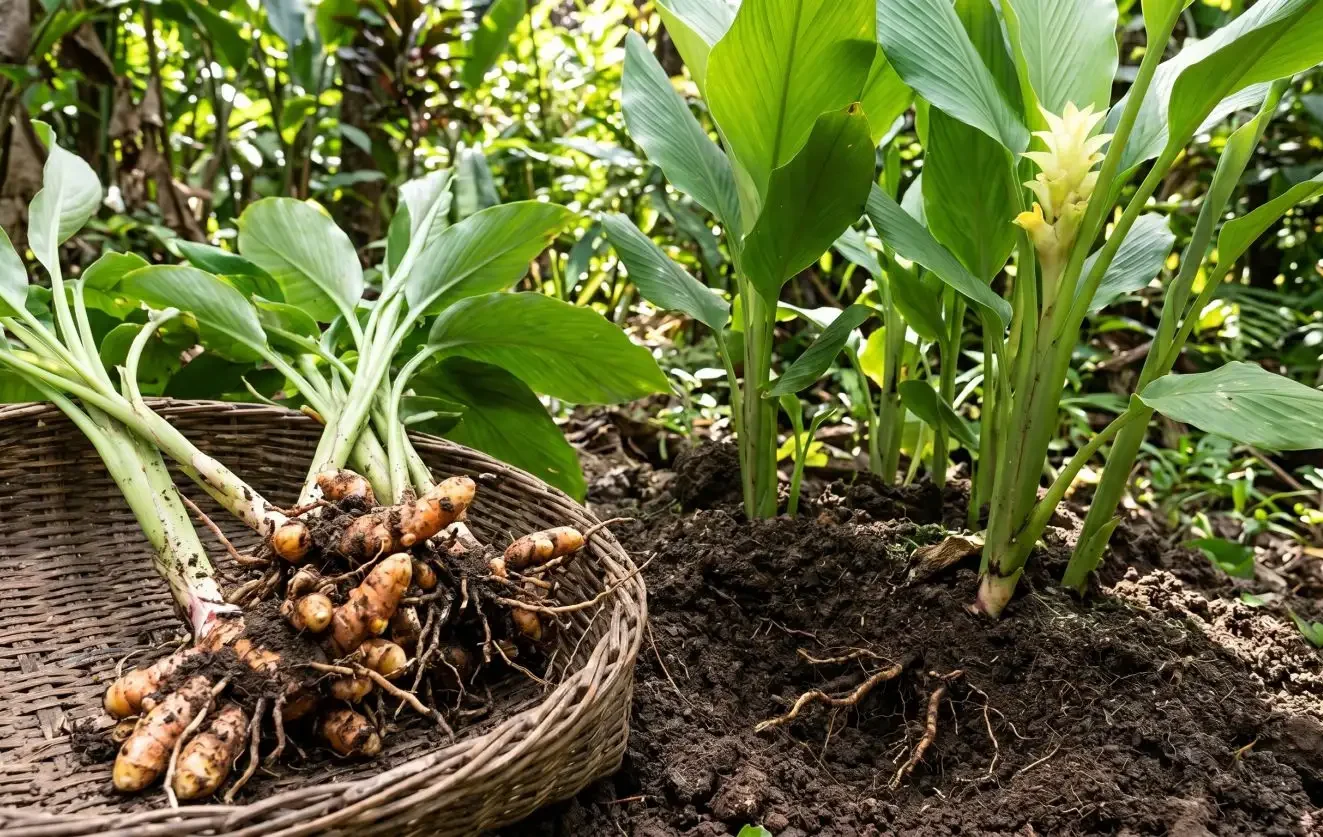
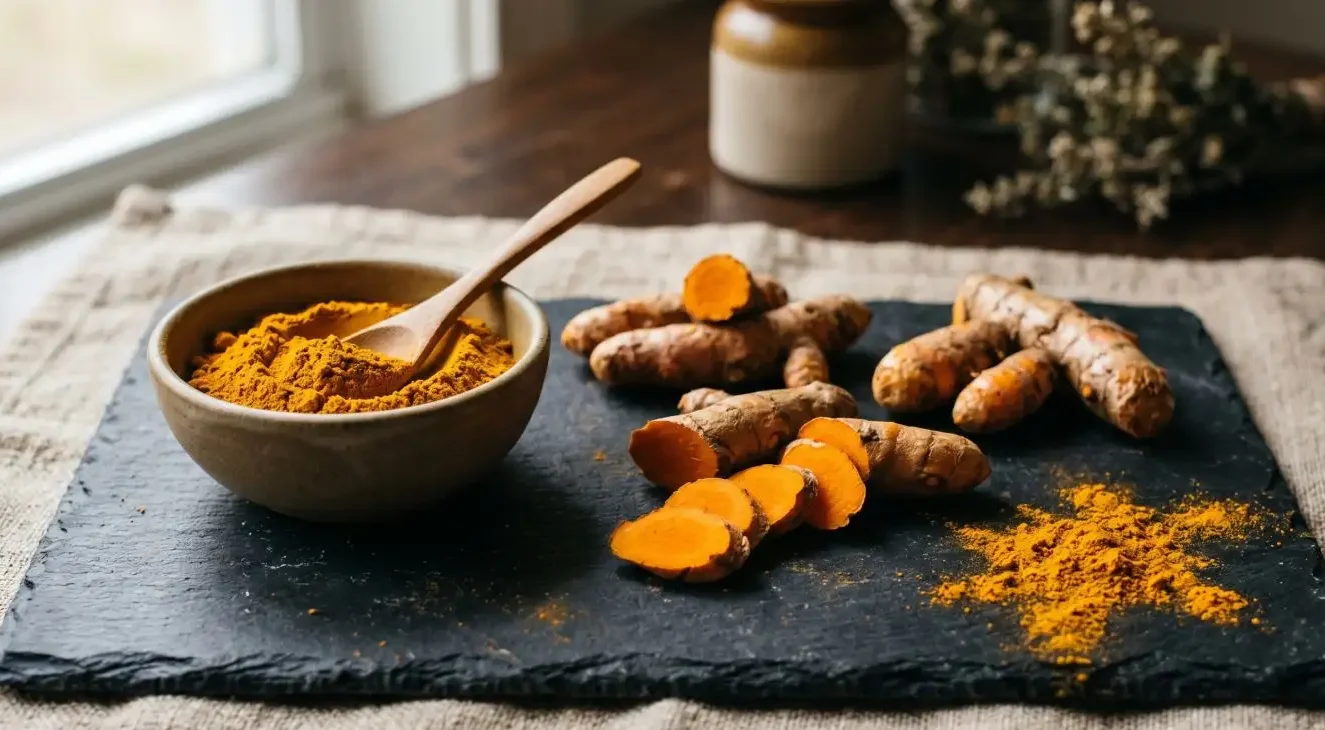
Turmeric comes from Curcuma longa, a perennial plant in the ginger family native to South Asia. It grows in warm, humid tropical conditions and is cultivated primarily in India, which produces roughly 80% of the world’s supply and has done so for as long as trade records exist. The part of the plant used is the rhizome — the dense, knobbly underground root system, similar in structure to ginger root. When dried and ground, the vivid orange-yellow flesh becomes the familiar golden powder.
The colour comes from curcuminoids — a group of polyphenolic compounds of which curcumin is the most abundant and most studied, making up roughly 77% of the curcuminoid content in the dried root. The remaining curcuminoids, demethoxycurcumin and bisdemethoxycurcumin, are also bioactive but attract far less research attention. When people talk about the health properties of turmeric, they are almost always talking about curcumin specifically.
Turmeric has no known wild ancestor. It was domesticated thousands of years ago in India and has been cultivated ever since. It spread to China around 700 AD, reached East Africa by 800 AD and West Africa by 1200 AD, and arrived in Europe in the thirteenth century, reportedly introduced by Marco Polo. Today it is grown across South and Southeast Asia, parts of Africa, and the Caribbean, but India remains the centre of production and the deepest source of traditional knowledge about its use.
A Spice That Has Never Stopped Being Useful
The medicinal history of turmeric dates back at least four thousand years. Archaeological evidence — residue from cooking pots excavated near New Delhi — confirms its use in food preparation as early as 2500 BCE. By around 500 BCE it had become a central ingredient in Ayurveda, the Indian system of medicine, where it was used for an extraordinarily broad range of conditions: digestive complaints, respiratory congestion, joint pain, wounds, skin conditions, and as a general tonic for purifying the blood.
Ayurvedic literature contains over a hundred different terms for turmeric. One of them — Jayanti — translates as “one who is victorious over diseases.” Another — matrimanika — means “as beautiful as moonlight.” This is not the vocabulary of a minor ingredient. Turmeric occupied a central place in Indian traditional medicine in a way that very few single ingredients do.
Beyond medicine, turmeric held deep cultural and spiritual significance. In Hindu tradition it was considered auspicious and sacred — applied in wedding ceremonies, used in religious rituals, worn as protective amulets in some Pacific Island cultures. The yellow dye it produces was used to colour the robes of Buddhist monks. In Ayurvedic practice it was placed on the foreheads of newborns as a blessing. The reach of this single plant across culture, religion, medicine, food, and textile tells you something about how integrated it was into daily life across large parts of Asia.
Traditional Chinese medicine adopted turmeric for invigorating blood circulation and relieving pain. Traditional medicine systems in Thailand, Malaysia, Indonesia, and Japan all used it for overlapping purposes — digestive support, anti-inflammatory applications, skin treatment. The consistency of use across independent traditions, in cultures that had no contact with one another, is the same pattern that shows up with frankincense and galbanum: a signal that the ingredient is doing something real.
Curcumin: What It Is and How It Works
Curcumin is a polyphenolic compound — specifically a diarylheptanoid — and it is responsible for turmeric’s yellow colour and most of its documented biological activity. It was first isolated in 1815, and serious scientific interest in its properties began building in the latter half of the twentieth century. Today it is one of the most studied natural compounds on earth, with tens of thousands of published papers.
The core mechanism that makes curcumin interesting to researchers is its effect on inflammation. At a molecular level, curcumin inhibits the activation of NF-κB — nuclear factor kappa B — a signalling protein that acts as a master regulator of the inflammatory response. When NF-κB is active, it switches on genes that produce pro-inflammatory cytokines including TNF-α, interleukin-1, and interleukin-6. Chronic overactivation of this pathway is implicated in arthritis, inflammatory bowel disease, cardiovascular disease, neurodegenerative conditions, and certain cancers. Curcumin’s ability to interfere with this pathway — and several others including the COX enzyme pathway relevant to prostaglandin production — gives it a broad anti-inflammatory profile that explains why it keeps showing up across so many different research areas.
It is also a potent antioxidant, scavenging free radicals and upregulating the body’s own antioxidant defence systems. These two properties — anti-inflammatory and antioxidant — together account for most of the clinical interest in turmeric across conditions ranging from joint pain and skin health to brain function and digestive disease.
Important context: the volume of research on curcumin is large, but the clinical picture is still developing. Many studies are in vitro or animal models. Human clinical trials show promising results for certain applications — arthritis and joint pain in particular — but the evidence base is not yet as settled as it is for some pharmaceutical interventions. This does not diminish the traditional record or the biological plausibility of curcumin’s effects. It means the science is still accumulating, which is different from the science being absent.
Traditional and Researched Uses
Inflammation and Joint Pain
Turmeric’s most prominent traditional use — and its most researched modern application — is for inflammatory conditions. Ayurvedic physicians prescribed it for joint pain and rheumatic complaints for thousands of years before anyone understood the NF-κB pathway. A substantial number of clinical trials have since tested curcumin supplementation in osteoarthritis, rheumatoid arthritis, and general joint discomfort, with consistently positive results in reducing pain and improving function. A 2016 systematic review and meta-analysis found that curcumin supplementation significantly reduced pain and improved physical function in patients with arthritis compared to placebo, with an effect size comparable to ibuprofen in some studies.
This is one of the stronger areas of clinical evidence for curcumin — not definitive, but meaningfully supported across multiple independent trials.
Skin Health
Turmeric’s application to skin is ancient. Ayurvedic practice used it for wounds, burns, bruises, blemishes, and inflammatory skin conditions including eczema and psoriasis. The traditional habit of applying turmeric paste to the skin before ceremonies — still practised in many South Asian cultures today — reflects a long-standing recognition of its skin benefits.
Modern research supports this. A 2016 systematic review in Phytotherapy Research examined 18 clinical studies on turmeric and skin health across conditions including acne, atopic dermatitis, psoriasis, facial ageing, and wound healing. Ten of the 18 studies found statistically significant improvement in the turmeric or curcumin treatment groups compared to controls. A 2025 clinical scoping review examined 19 clinical trials specifically on curcumin and wound healing and found that curcumin improved healing outcomes compared to placebo or conventional care in 89% of studies, with no adverse events reported in 84% of them.
The skin mechanisms are well documented. Topically applied curcumin accelerates the wound healing process by reducing inflammation in the early phase, promoting collagen synthesis, supporting fibroblast migration, and increasing vascular density in healing tissue. Its antimicrobial properties also reduce the risk of wound infection. For inflamed, reactive, or slow-healing skin, these are meaningful properties — and they function at the site of application rather than requiring systemic absorption.
There is one practical note worth knowing: turmeric stains. The vivid yellow-orange pigment will temporarily tint very pale skin and can mark light-coloured fabrics if not absorbed fully before contact with clothing. This is not a safety concern — it is simply the nature of the dye. Allow balms and creams containing turmeric to absorb fully before dressing.
Digestion
Traditional medicine across Ayurveda, Chinese medicine, and Western herbal practice used turmeric as a digestive bitter — stimulating bile production, reducing bloating and gas, and easing indigestion. Bile is produced by the liver and stored in the gallbladder; it plays a central role in the digestion of fats. Research has confirmed that curcumin stimulates bile secretion, which gives the traditional digestive use a plausible biological mechanism. It has also been studied for inflammatory bowel conditions including Crohn’s disease and ulcerative colitis, where its NF-κB inhibiting properties are relevant to the chronic intestinal inflammation involved.
Brain Health
One of the more intriguing areas of curcumin research is its potential effect on cognitive function. Traditional Ayurvedic medicine categorised turmeric as a brain tonic — used to support mental clarity and memory. The modern research interest stems partly from epidemiological observations: India has among the lowest rates of Alzheimer’s disease in the world, and some researchers have speculated that high dietary turmeric consumption may be a contributing factor, though this is difficult to establish definitively.
Curcumin has shown the ability to cross the blood-brain barrier and has been studied for its effects on brain-derived neurotrophic factor (BDNF), a protein that supports the growth and maintenance of neurons. It has also been investigated for its effects on beta-amyloid plaques relevant to Alzheimer’s pathology. The research is preliminary and the clinical trials have produced mixed results, but the neurological dimension of turmeric is an active and genuinely interesting area of investigation.
The Absorption Question
Turmeric is one of those ingredients where knowing how to use it makes a significant difference, particularly for oral consumption. Curcumin has notoriously poor bioavailability when consumed alone — it is rapidly metabolised in the intestinal wall and liver and eliminated from the body before much of it reaches the bloodstream. Studies have found that a standard dose of curcumin alone can result in almost undetectable blood levels.
Two practical interventions significantly improve this. The first is black pepper. Piperine — the active compound in black pepper — inhibits the liver enzymes that break curcumin down rapidly, increasing bioavailability by up to 2,000% in some studies. The landmark research on this was published in Planta Medica in 1998 and has been replicated multiple times since. Adding even a small amount of black pepper to food containing turmeric — which traditional South Asian cooking has always done — dramatically changes how much curcumin actually reaches circulation.
The second is fat. Curcumin is fat-soluble rather than water-soluble, which means it is absorbed far more effectively when consumed alongside dietary fat. Cooking turmeric in oil, as curries do, or consuming it with a meal containing healthy fats rather than on an empty stomach, meaningfully improves absorption. Traditional culinary practice — turmeric cooked in ghee, rendered beef tallow, or in a fat-rich curry — turns out to be scientifically well-founded.
Note on topical use: the absorption question applies primarily to oral supplementation. When turmeric is applied topically in a balm or cream, the curcumin acts locally at the site of application — reducing surface inflammation and supporting wound healing — without needing to navigate the digestive system. The bioavailability concern is less relevant for topical products.
Turmeric at Toeka
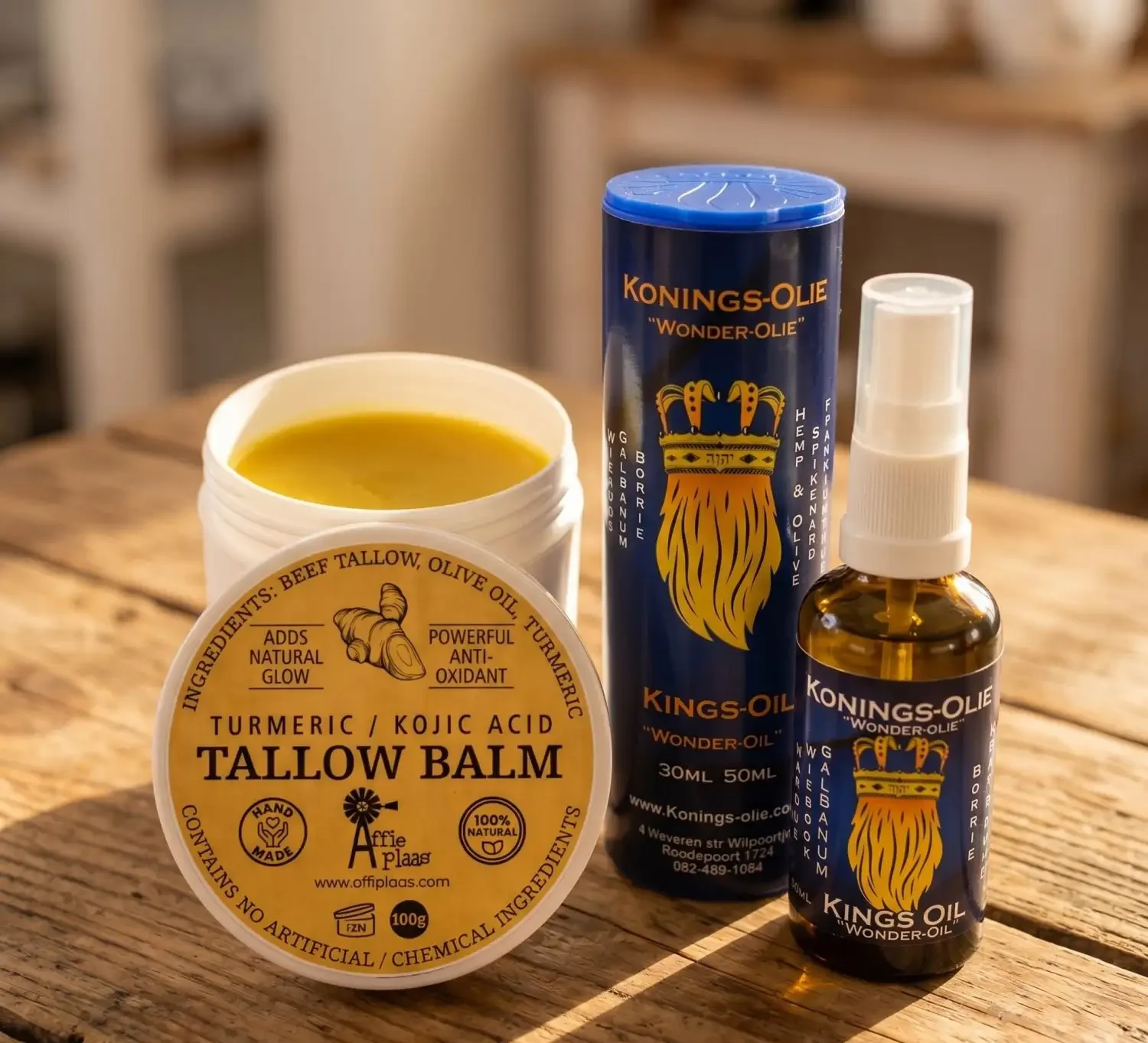
Turmeric appears across several products in the Toeka range. In Kings-Oil Wonder Oil it is one of the four botanical oils in the formulation, contributing its anti-inflammatory and antioxidant properties alongside frankincense, spikenard, and galbanum. The combination draws on a tradition of multi-ingredient healing preparations; these oils have historically been used together rather than in isolation.
In the Affieplaas tallow balm range, turmeric is paired with beef tallow and olive oil in the Tallow Balm Skin Cream — Turmeric. The combination is straightforward and well-founded: tallow is highly compatible with the fatty acid profile of human skin, and turmeric contributes its anti-inflammatory and wound-healing properties directly at the skin surface. For dry, reactive, or inflamed skin, the combination addresses both the barrier function (tallow) and the inflammatory driver (curcumin). The Tallow Balm Skin Cream — Turmeric with Kojic Acid takes this further, adding kojic acid to the turmeric for a formulation specifically aimed at hyperpigmentation and uneven skin tone.
The Waterberg Organics Turmeric Powder is turmeric as it should be: single ingredient, no additives, ready for the kitchen. Add it to curries, soups, stews, and rice dishes — and pair it with black pepper and a fat-containing meal for the best results.
A Note on Use
Turmeric used in cooking at normal dietary amounts is widely recognised as safe. Ayurvedic literature contains over a hundred terms for it precisely because it was considered a food as much as a medicine — consumed daily across large populations for thousands of years without systematic harm.
Higher-dose curcumin supplements are a different proposition. If you are pregnant, breastfeeding, taking blood-thinning medications, or have a gallbladder condition, consult a healthcare professional before taking curcumin supplements. Curcumin can stimulate bile production, which is beneficial for most people but should be approached cautiously in the context of gallstones. It also has mild anticoagulant properties that may interact with blood-thinning medications at supplemental doses.
For topical use in balms and creams, the primary consideration is the staining note above. Turmeric can temporarily leave a yellow tint on very pale skin and will stain light-coloured fabrics if not fully absorbed before contact. This fades naturally and is easily managed.
Products containing turmeric — including Kings-Oil Wonder Oil and the Affieplaas tallow balm range — are complementary health products and have not been evaluated by SAHPRA for quality, safety, or intended use. They are not intended to diagnose, treat, or cure any medical condition.
Still Working After Four Thousand Years
Most spices that have been in use for four thousand years do not also appear in tens of thousands of peer-reviewed research papers. Turmeric does both. The Ayurvedic physician prescribing it for joint pain in 500 BCE and the rheumatologist running a clinical trial on curcumin and osteoarthritis in 2024 are separated by two and a half millennia, different methods, different languages, and different conceptual frameworks — and they are arriving at substantially the same conclusion.
That kind of convergence, across independent traditions and modern laboratory science alike, is what makes turmeric worth understanding rather than simply using. It is not just a spice. It is one of the most thoroughly documented medicinal plants in human history, and the research is still accumulating.


